

Outdoor Heaters are available in several forms, with electric and gas being the two most common choices for residential patios and alfresco areas.
In this overview, we explore these different types of heaters to help guide you on which choice may be the best for you. We look at a general overview of the different types, the running costs, some points around the installation & maintenance and look at applications of where they are best used.
Our aim here is to give you an unbiased guide on the two types, so that you can select an option that best works for you.
General Overview
Electric Outdoor Heaters
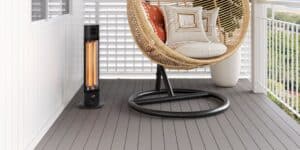
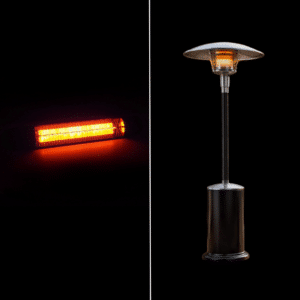
Electric heaters use infrared heat, which depending on the type of unit, may be to warm people & surfaces or to heat the space.
- Instant heat
- Range of different element types and ways the heat is radiated.
- Silent operation
- No open flame
- Low maintenance
- Range of designs, mostly suitable for wall or ceiling mounting
- Some options allow the heater to be set to a desired temperature
- Heat output is measured in Kilowatts or Watts
Gas Outdoor Heaters
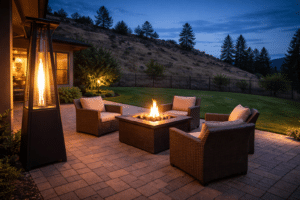
Gas heaters burn propane or natural gas to heat a metal mesh screen or cover, which then radiates heat by infrared.
- Range of fixed and portable options
- No electrical installation required, gas install required for fixed options
- Large heat output to cover larger areas
- Rapid heat up
- Low maintenance
- Portable units will require gas bottles to be refilled as they run out
- No impact on your houses electricity load
- Heat output is measured in Megajoules
Running Costs
Running cost is a key factor when looking at the different types of Outdoor Heaters
To compare running costs fairly, we will use the below as our base line:
- Electricity: $0.40 per kWh
- LPG bottle: 9kg for $35.00
- Natural gas: $14.87 per thousand cubic feet (MCF)
Electric Outdoor Heaters
Heater Output Cost Per Hour (40c/kWh)
1200 W $0.48
1800 W $0.72
2000 W $0.80
2400 W $0.96
2500 W $1.00
Example:
A 2000 W (2kw) electric heater running for three hours costs approximately: $2.40 per evening.
Gas Outdoor Heaters
Portable Gas Heaters
A standard 9 kg (8.5 kg fill) LPG bottle contains roughly 417–440 MJ of energy, providing about 8–10 hours of heating for a typical portable heater on high, or up to 15+ hours on low. The gas bottle price used is based on $35 for a gas bottle refill as an average.
Estimated cost per hour:
$2.30 on low to $4.40 on high per hour
Example
A portable gas heater that has a 10 hour life on high, running for three hours on high would cost $10.50
Fixed Natural Gas Heater
Fixed gas heaters connected to a natural gas supply are usually cheaper to run than portable heaters. As a guide, a heater will typically use around 3.6 MJ (Megajoule) per kilowatt hour.
Typical prices are between 3c-5c per MJ.
Example
As an example, a 2KW unit would be using approx. 7.2MJ per hour, 2kw x 3.6MJ = 7.2
7.2MJ an hour at 4c per MJ = $2.8 per hour, by 3 hours = $8.64
In Summary
Heating costs per hour based on the above examples:
Heater Type Typical Cost Per Hour
Electric Heated $0.80
Portable Gas Heater $3.50
Fixed Mains Gas Heater $2.80
Installation Considerations
Installation requirements differ between heater types.
Electric Outdoor Heaters
Electric Outdoor Heaters can be:
- Wall mounted
- Ceiling mounted
- Freestanding
- Plug-in or hardwired depending on output
Ceiling-mounted heaters are common in alfresco areas because they can distribute heat evenly across seating areas without taking up floor space.

Gas heaters
Gas Outdoor Heaters are typically freestanding units connected to LPG cylinders.
They require space around the heater for safe operation and ventilation.
Because heat rises from the flame, they are often less suitable for ceiling or wall installation.
Maintenance and Usage
Maintenance requirements also vary significantly.
Electric heaters
Electric Outdoor Heaters generally require minimal maintenance.
Typical care includes:
- Occasional cleaning
- Checking mounting brackets
- Ensuring electrical connections remain secure
Because electric heaters do not burn fuel, there are no gas lines or combustion components to maintain.
Gas heaters
Gas Outdoor Heaters require more regular attention.
Maintenance tasks may include:
- Replacing gas bottles
- Checking regulators and hoses
- Cleaning burner components
- Monitoring flame performance
Gas heaters also require safe storage and handling of LPG cylinders.
Which Outdoor Heater Type Is Best for your space?
The best option depends on the space and how the heater will be used.
Electric infrared heaters are often preferred for residential patios and alfresco areas because they provide direct warmth, quiet operation, and lower maintenance.
Gas heaters remain useful in situations where electricity is not available or where portability is the main priority.

Final Thoughts
Outdoor Heaters vary widely in performance, installation requirements, and operating cost.
Electric infrared heaters typically provide targeted heating for patios, balconies, and alfresco areas, with predictable running costs and minimal maintenance.
Gas heaters offer mobility and high heat output but generally come with higher running costs and more ongoing upkeep.
Choosing the right Outdoor Heater involves balancing comfort, installation requirements, and long-term operating costs to suit your outdoor space.